


Six minutes into a match your hero is standing at the edge of a clearing looking at four ogres and the mound they live in. Killing them pays gold, a level, and whatever drops. It also costs you the army you brought, if you brought the wrong one. Nothing made you walk over there.
That decision is the thing this post is about. Between the first worker and the first real fight there is a stretch of an RTS match where a player has issued every order currently available and is waiting for a timer. A map that is two bases and some trees has no answer to that. This one fills the gap with things that belong to neither side: 15 kinds of creep across 7 families, four mercenary buildings that hire 18 units no faction can train, and a shop that opens only when a hero walks up to it.
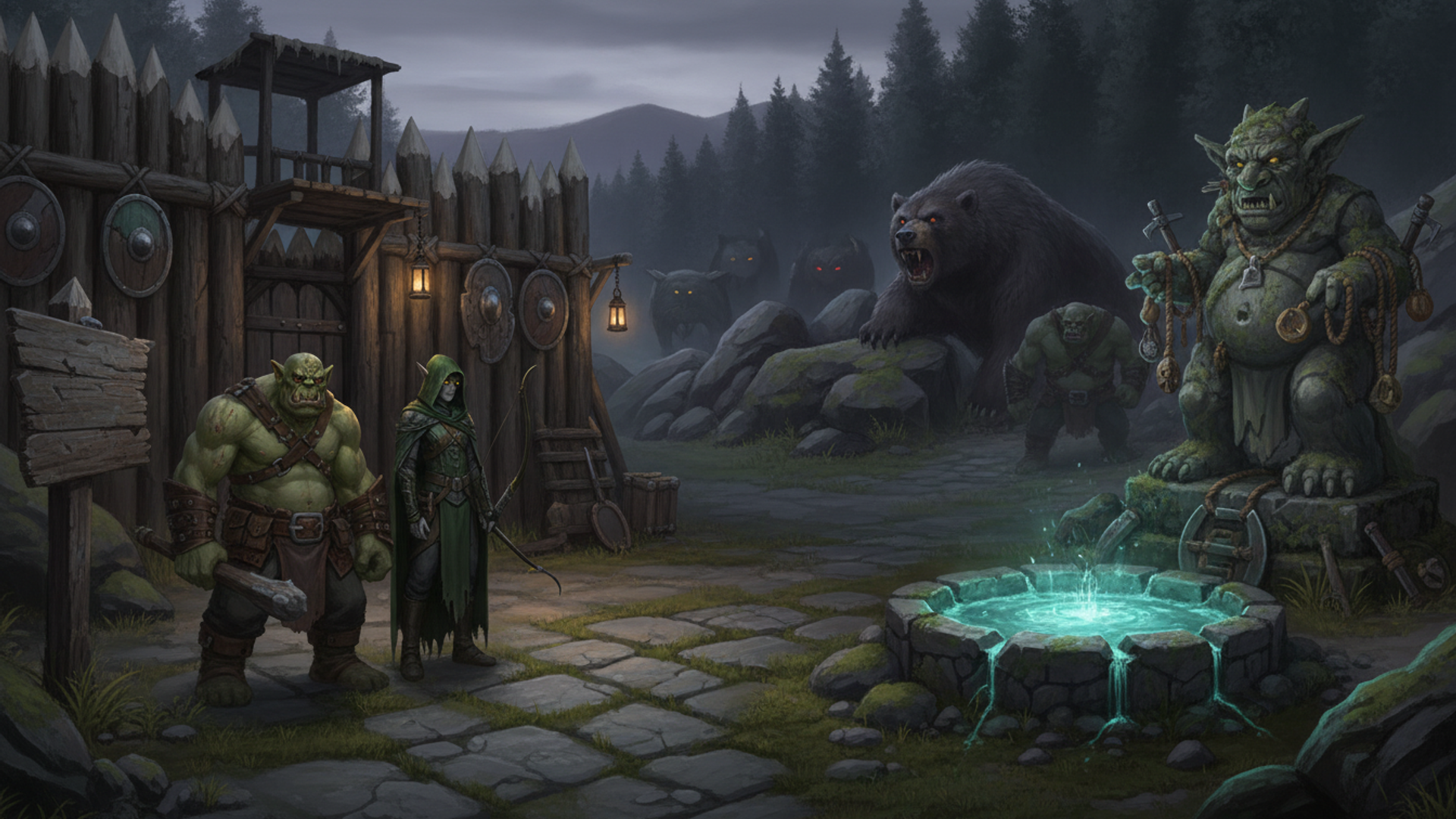
A camp is a decision, not scenery
The important property of a creep camp is that it does not come to you. Camps sit dormant until one of your units or buildings comes within 20 tiles, and even once awake a creep drifts back to its home at 12 tiles and is dragged back hard at 18. They are kept off your doorstep by construction, too: no camp is ever generated within 28 tiles of a starting position, which is the wake-up range plus eight.
So a camp is a thing you choose to walk into. What you get for it is gold, experience for whichever hero landed the killing blow, and a roll on that camp's loot. What you risk is the army you brought. Camps get harder the further they sit from the bases, and bigger maps carry more of them, so the far expansion is guarded by tier-3 ogres and the one next door is guarded by kobolds.
Two details make it cheap to build a mode around. Creeps cost zero population, so they never interact with either player's supply. And the experience a hero earns is worked out from what the creep would have cost to build, which means the reward scales with the creep's strength automatically, rather than from a second table of experience values that can drift out of step.
The goal was stated in one line when the feature was asked for, and it is a design goal rather than a feature list:
giving heroes something to do between fights and making neutral structures contested.
Dead creeps come back after 45 to 90 seconds, jittered, so a cleared camp is a temporary advantage rather than a permanently solved problem. What brings them back is the den or cave they came out of, and that building can be destroyed, so a player who wants the spot for good can pay for it properly.
Seven families, and one that is not an animal
The seven families are kobold, wolf, bear, troll, ogre, pirate and golem, and each has a building that houses it: a den, a cave, a hut, a mound, a wrecked ship for the naval one. Land creeps take one tile and the pirate ships are two-by-two naval units, so an island map gets guarded water the same way a land map gets a guarded ridge, which you can see laid out across the map library.
The golem family is the odd one and the best one. Its building is the Ancient Runestone, which raises Rune Golems rather than housing them, and behind that sits The Shaper, the campaign's final boss, which is also a creep in the technical sense: it pays a bounty, drops loot and grants hero experience like anything else in a camp. Reusing one system for a wandering bear and for the thing the whole story is about is the sort of decision that only looks elegant afterwards, and it is why bosses did not need a reward path of their own.
Everything a camp drops is drop-only. There are 26 such items, none of which any shop can ever stock, tuned to land roughly 10 to 15 percent stronger than bought gear of the same rarity. That gap is the reward argument for clearing camps, and the item system and the gambling den are where the rest of it lives.
Filling the dead time on any map, not just this one
The problem underneath all of this is portable and it is not about monsters. In any game with a build phase, there is a stretch where the player has issued every order that is currently available and is waiting for a timer. Terrain does not fill it, because terrain carries no risk and pays nothing. A second base does not fill it either, because expanding is the same activity again. What fills it is an optional, priced risk that pays in a currency the player already wants.
Three properties separate that from a chore, and each is a decision you can make wrongly.
It has to not come to you. A camp sits dormant until approached, returns to where it started, and cannot appear inside a ring around a starting position. The moment neutral monsters wander into a base, the mechanic stops being an opportunity the player chose and becomes a timer they have to survive, which is a different design and a much less interesting one.
Price it with geography rather than with a rule. Making camps harder the further they sit from the starting positions says "this is what you can afford to want" without a single line of explanatory text, and a player learns it by losing one army once. A difficulty number printed on a camp does the same job and has to be read. A camp that is further away does not.
Do not let it be permanently solved. Clearing a camp should be a temporary advantage, so bring it back on a jittered timer, and let the building be destroyed so a player who wants the ground for good has a way to pay for it properly. Permanent clears turn the middle of a match back into the empty map you were trying to fix.
The cheap engineering trick underneath is worth as much as the design. Derive the reward from numbers the thing already carries, the way hero experience here comes from what the creep cost, rather than authoring a second table saying how much each thing is worth. Two tables describing the same power level will disagree within a month, and the one that goes unchecked will be the one players feel.
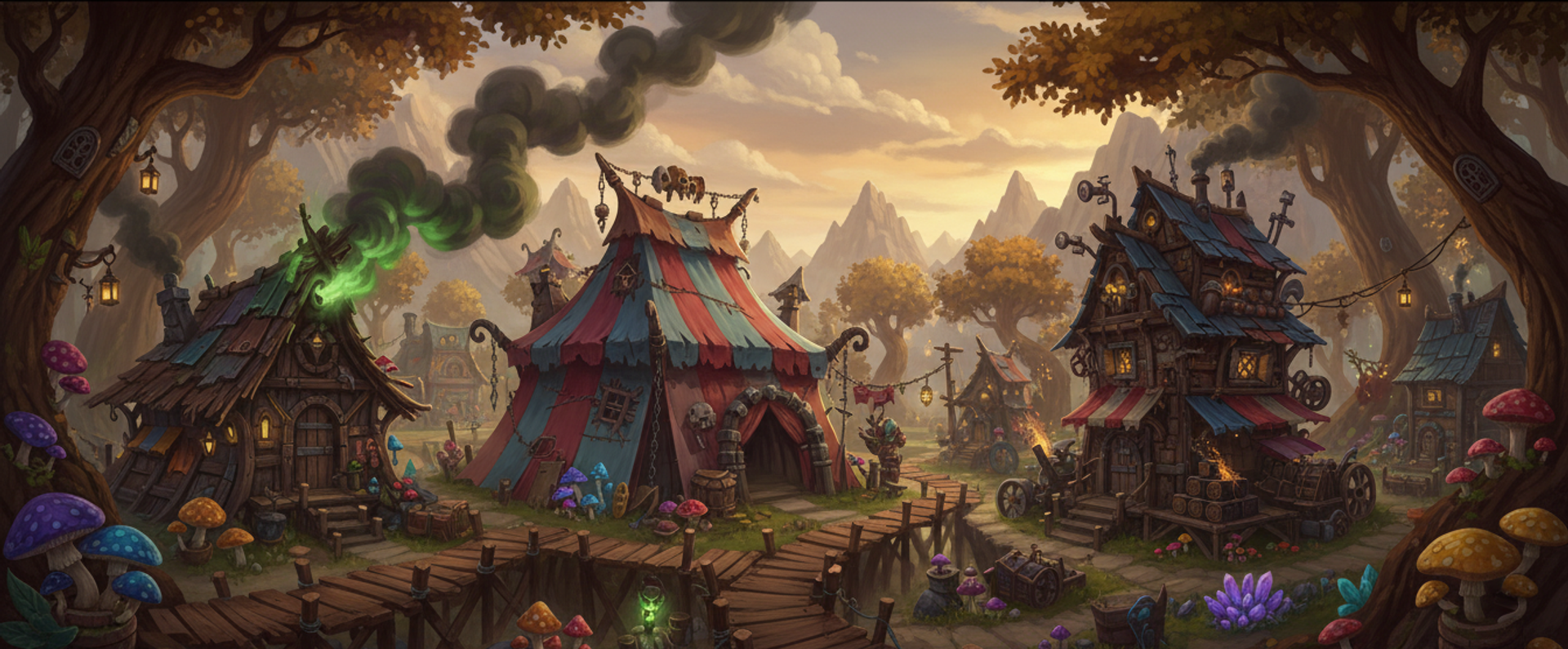
Buildings that take no side
Four neutral buildings hire units, none of which belong to any faction, and all of them cost nothing to place because the map places them:
| Building | Hires | What |
|---|---|---|
| Mercenary Camp | 6 | Ground: ranger, berserker, ogre, witch doctor, harpy, stalker |
| Feathercrest Aerie | 6 | Flying, from a scout hawk up to a roc matriarch |
| Verdant Runic Spire | 3 | Casters, carrying 7 spells of their own |
| Pirate Platform | 3 | Naval, and it is a water building |
Those 18 units are in no faction's roster and cannot be researched into existence. You take the building's ground, you pay gold, and each unit type restocks on a cooldown of roughly two to six minutes scaled by its cost, with the countdown shown while you are standing there. A Feathercrest Aerie on a map where your own tech tree has no air units is therefore a real strategic object rather than flavour. It is the only air you are getting.
The Troll-Vault is the neutral item shop, an ancient troll statue turned merchant vault, and it opens because a hero is standing near it rather than because you opened a menu. The Gambling Den is four tiles square and takes gold for random, level-scaled loot. Health and mana pools restore 2 health and 1.5 mana per second to anything within 3 tiles, which turns a pool into a position worth holding during a fight rather than somewhere to top up afterwards. And eight kinds of critter wander the map depending on its type: sheep, deer, boar and rabbit inland, seagull, crab, seal and pelican on water maps, with 3 to 8 hit points each and no purpose beyond being alive.
All of this is what makes heroes worth having. The three hero resource models solve the problem of a hero being boring to pilot. The neutral world solves the problem of a hero having nowhere to go. The AI opponent clears camps too, and the way it thinks includes farming level-appropriate ones when its hero is not needed in a fight, which was much easier to write than it sounds, because a camp's difficulty is already legible from where it sits.
The neutral player is player 8
Creeps are owned by a real player slot rather than by nothing at all, and that player's number is 8, one past the maximum a match can seat. That is not decoration. Hostility in this engine means "belongs to a different player", so making creeps a player means the existing target acquisition handles both creeps attacking you and your units attacking creeps with no new code at all. The victory check only ever looks at the two sides that can win, so the creep player can neither win nor lose.
It used to be player 2, which was fine while a match had two seats. When the game went from a hardcoded 1v1 to eight players that number became a real player slot, so it moved to 8, and older maps are migrated as they load.
The bug: one neutral shop, and neither player got a base
Custom maps decide whether to hand out starting units by asking whether the map already contains buildings. That test counted every building, which is correct right up until a map carries a neutral structure. A single Troll-Vault or one creep den made the count non-zero, so the game concluded both players already had bases and gave them nothing: no town hall, no workers, an empty map and two players with no way to do anything at all.
It was found the way that kind of bug always is, by loading a map that had one and watching the match start with nothing on it. The fix, in August, is to count only buildings that belong to a player. The check matters enough that the map importer re-runs it on every pass and prints a blocking error if it has regressed, because the failure is total and the cause is three tiles of scenery.
A faction with a page and no play button
The Wilds has an emblem, a banner, splash art, a tagline ("The land answers to no banner") and its own page at /factions/wilds, sitting in the site's faction bar alongside the nine you can play. It is marked non-playable, it has no units of its own, and its buildings are the four mercenary halls plus the Troll-Vault. It also does not count: the playable faction total is computed from the playable list specifically so the neutral entry cannot inflate it, which is why 9 is the roster figure everywhere on the site.
Giving the map's own content a page turned out to be the clearest way to answer a question players ask constantly, which is what all that stuff on the map actually is.
Which is the whole argument for building any of it. Two bases and some trees is a map where the only thing to do is the thing you were already doing. Fifteen kinds of creep, four halls hiring eighteen units nobody can train, a shop that opens for a hero and a casino that takes your gold is a map with somewhere to go while you wait.


