

Every hero should feel like a class you are playing, not a unit you are ordering around.
That was the ask, and it arrived with a specific complaint attached. The game already let you drop into a hero: press a cheat and the camera swings in behind its shoulder, movement goes to the keyboard, and an action bar appears along the bottom of the screen. But that bar only carried the three abilities the hero had learned while it was an ordinary unit. There was nothing to cycle through, no build-up and no payoff, and no reason to press more than one button.
The promise of dropping into a hero is "I am playing my class". Standing in a fight watching a row of cooldowns flash red breaks that promise in about one second.
Four words from role-playing games do the work in this post, so: a kit is the set of abilities one character has. A cooldown is the wait before an ability can be used again, which is what stops you pressing the good button forever. To channel something is to stand still doing it for a few seconds, interruptible if you are hit. And a rotation is the order an experienced player presses their buttons in, which emerges from the cooldowns and costs rather than being written down anywhere.
The fix was a rule rather than a number: the player should always have a meaningful button to press. Everything follows from it, including writing 64 new abilities across the roster and taking every hero from four abilities to six.
What dead time feels like, and why it is fatal
A caster in the normal strategy game with nothing to cast just swings its staff and you never notice, because you are looking at your base. A hero you are personally driving with nothing to cast is a character standing still in a fight while you mash keys that flash red at you. One second of that reads as a bug. Three seconds reads as a bad class.
So the target is not "the hero has enough abilities". It is that the cooldowns interleave. Every kit follows the same cadence: something around two seconds, secondaries at six to eight, a finisher at four, defensives and escapes at ten to fifteen. Those spacings are chosen so that when the finisher is down the secondary is coming back, and the short one is always available, because being always available is what it is for.
Three economies, so a warrior is not a mage with a sword
Every hero runs on exactly one of three resources, and the resource is what sets the rhythm of your hands. The bar under the portrait is coloured to match: orange rage, yellow energy, blue mana.
Rage runs from 0 to 100, is generated only by landing attacks, never refills on its own, and drains away when you leave combat. You have to fight to fuel your buttons, which makes the opening of a fight feel different from the middle of one. Borin the Protection Warrior, Grizzik the Fury Warrior, Vargath the Death Knight and Grindspark the Juggernaut all run on it.
Energy with points refills quickly, and the refill rate is what paces you rather than any cooldown. Cheap abilities grant points, combo points for rogues and Marks for hunters, and the expensive ones spend three of them at once for an outsized payoff. The cap on stored points is the throttle. Thornwatch, Sorvalis and Vaeleth are the rogues; Sigrid, Whisper, Aethis, Baron Theobald and Ashglimmer are the hunters.
Mana is a large pool that refills slowly and steadily, so you cast what you can afford until you cannot. When you run dry mid-fight you channel Evocation, a refill every mana hero gets as an extra button, which is deliberately the one place a caster has to stop moving. That makes running out of mana a decision with a price rather than a state you sit in.
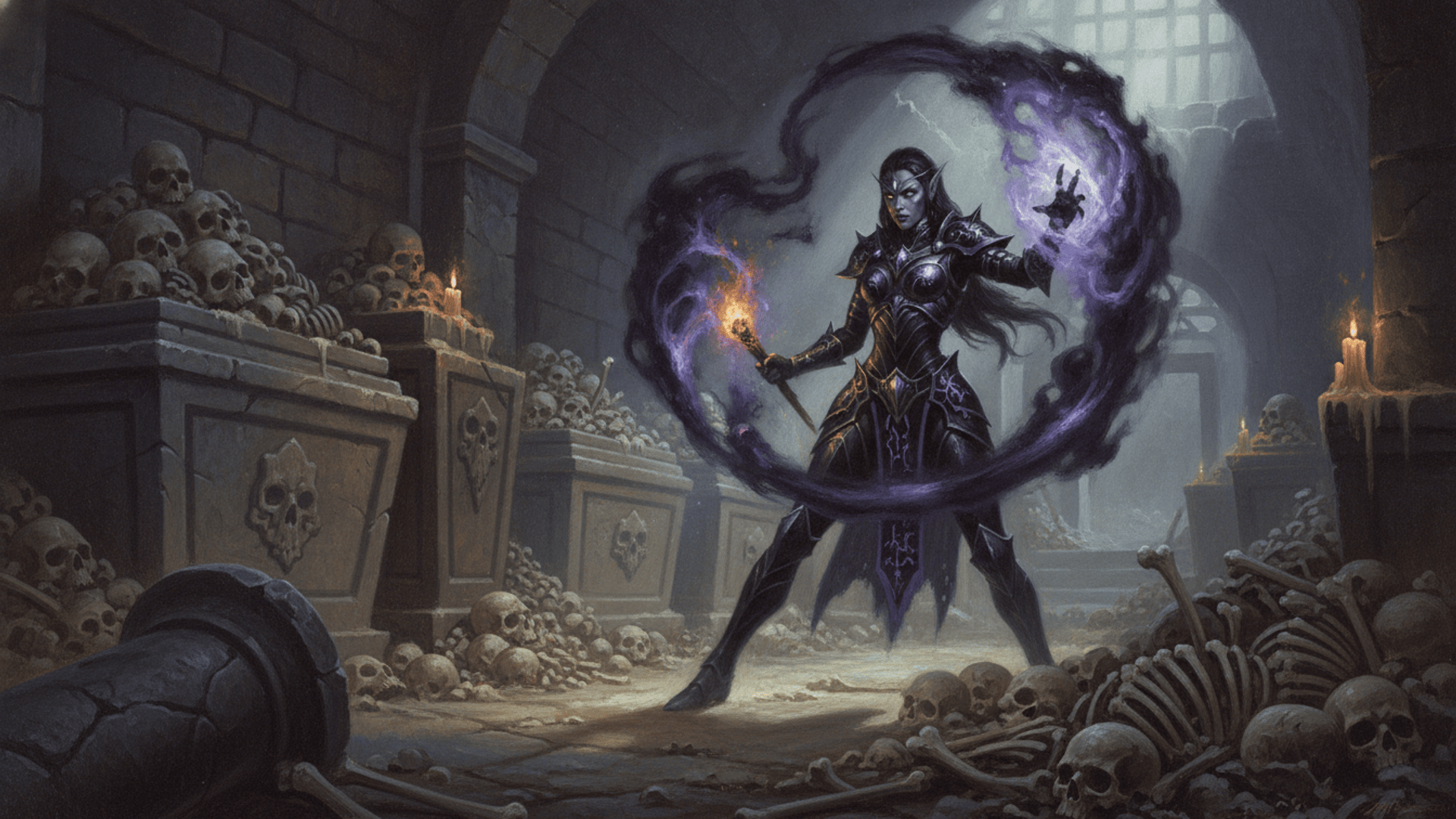
Across 96 heroes that lands roughly as rage for the tanks and bruisers, energy for marksmen and assassins, and mana for casters and healers.
Six abilities, twelve buttons
The action bar is the number row, 1 through =. The first six slots are the class kit. The next three are the abilities the hero learned as an ordinary unit, the choices made at levels 3, 6 and 9. The last three are item quick-slots, with the rest of the bag reachable by holding Shift.
Two extra slots went to every hero rather than only to the ones that felt thin, which is a judgement call worth naming. Patching only the thin kits would have been less work and would have left a roster where some classes have four buttons and some have six, so "how many abilities does this class have" becomes a thing a player has to learn per hero instead of a thing they learn once. A uniform shape is also the only version I can still hold in my head while writing the thirty-third hero.
The four abilities added to every kit were not filler. Read end to end, the missing pieces looked like a bug list: no way to hit a group for the heroes that were single-target only, no defensive cooldown at all for the squishy casters and assassins, no way to reposition for casters who could not blink, and four healers whose kits could only heal themselves. That last one is the sort of gap no count of abilities will ever surface. It took reading every hero one at a time.
At level 10 each hero gets a single ultimate on its own key, on a two to three minute cooldown, outside the six. There is exactly one per hero and they are deliberately not part of the rotation. A once-a-fight defining moment is a different design object from a spender.
How to check a kit for dead time before you build it
The no-downtime rule is portable, and it is not vague. Stated without our nouns: at every point where the player could act, at least one ability must be both off cooldown and affordable. That is a property of a kit and you can check it on paper, before any of it exists.
Write each ability as three numbers: how long its cooldown is, what it costs, what it gives back. Then walk a minute of fight one action at a time and mark every moment where the set of abilities that are simultaneously ready and affordable is empty. Every empty moment is dead time. One is a rhythm. Three in a row is what a player will call a bad class, and they will be describing an arithmetic property of the table you wrote rather than the fantasy you attached to it.
Building up to spending is what makes that property true by construction instead of by tuning, and it has three clauses that are easy to break one at a time.
- One ability has the shortest cooldown in the kit and gives resource back rather than costing it. Ours come back about every two seconds, which is often enough to cover every other opening on its own and leave the rest of the kit to cover the alternate ones.
- A payoff has to cost more than one build-up produces. If it does not, the player alternates two buttons forever and a six-ability kit is a two-ability kit wearing four decorations. Ours want three points.
- The ceiling on what you can store has to be low enough that sitting at it wastes generation. That is what turns spending into a decision instead of an option, and it is the clause most likely to be skipped, because a generous ceiling feels kind and quietly removes the pressure the resource existed to create.
Choose the resource for the rhythm it produces, not for the fantasy it suggests. Something generated only by hitting things makes the opening of a fight play differently from the middle. A fast-refilling pool moves the pacing off cooldowns and onto a refill rate, which is a much smoother dial to turn. A big slow pool makes budgeting across a whole fight the decision, and it needs an explicit refill button or running dry becomes dead time under another name, which is exactly the job Evocation does here.
The one second that stops a player dumping the whole kit
Driving a hero directly needed a governor the strategy game never did. There is one second between any two abilities in the kit, borrowed straight from the conventions of online role-playing games, so you cannot mash the number row and empty everything you have in a single frame.
It is scoped tightly. Only a hero under direct control gets it, so ordinary casters, the computer opponent, and drinking a potion are all untouched. Cast bars are opt-in for the same reason: most kit abilities go off instantly, because a wind-up on every button makes a caster feel sluggish, and the deliberate exceptions are Evocation and a hero's signature spells, where a wind-up reads as power and gives the other player something to interrupt.
Interrupting matters here, and a later visual pass is what made it read properly. A broken cast now scatters the gathered power in ash-grey shards instead of simply stopping, which is what turns an interrupt from something that happened into something you did.
Elemental leaning, without a death sentence
Each hero has a damage type and an optional strong and weak elemental pair. Holy heroes deal holy and shrug off shadow. Shadow heroes deal shadow and burn to holy. Sigrid the frost sniper resists frost and fears fire, and Krazok, being cold-blooded, is sluggish in the cold. Heroes still sit behind the deliberately flat hero armour from the damage and armour system, so an affinity is a lean rather than a hard counter.
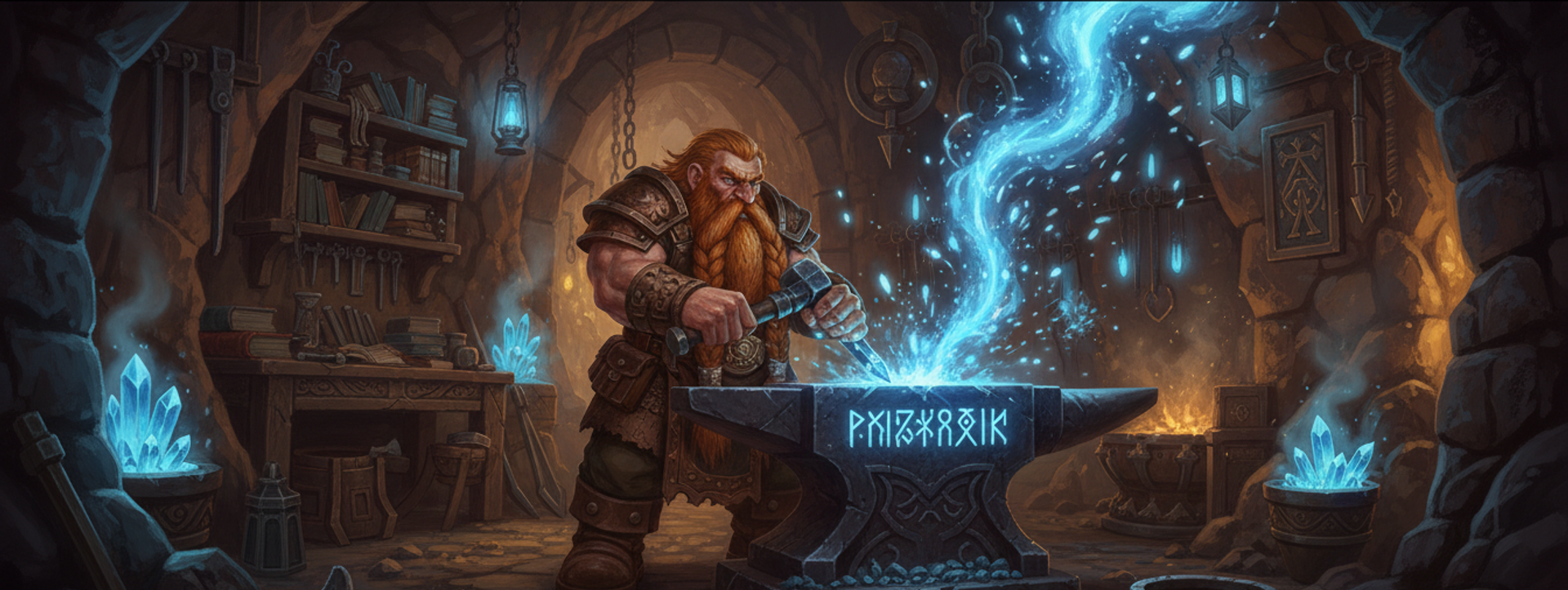
Writing that leaning down as a real property of the hero rather than as a line of description is what keeps it honest. If a hero's element exists only in its blurb, the next ability written for that hero will get it wrong and nothing will ever complain. Make the identity something the game itself consults, then check the blurb against it rather than the other way round.
Where to go and press the buttons
You can read every ability in the game, ordinary and hero kits together, on the ability inspector, and take a hero out in a skirmish to feel the difference between a rage bar you have to earn and an energy bar that refills on its own.
Driving a hero and commanding an army are two games sharing one character, and the answer to balancing both was to give every ability a separately tuned version in each. That costs more authoring and it means a spell can be right in both places at once, which shared numbers could never manage.
The place all of this gets stress-tested is the mode with no base to fall back on, which is the dungeon crawler mode inside the RTS, and the gear that feeds these kits their elemental riders is covered in loot, gear and a gambling den. The next thing I want here is a rotation simulator: something that walks a kit's cooldowns and costs for a minute of fighting and prints out the empty moments, so the no-downtime rule becomes a number I can read off rather than a bar I have to hold in my head while writing a kit.


