


Make the factions actually play differently, not just have different numbers.
That was the brief, and it is older than the game. It sits at the top of a page of design pillars Adam wrote before there was anything to apply them to: every faction should feel different to play, not just look different. A Ratmen player should feel the swarm. A Dwarf player should feel the weight of stone. Faction identity comes from mechanics first, aesthetics second.
If you have never played one, a real-time strategy game runs like this. You start with a town hall and a few workers. The workers gather gold, lumber and stone; the resources pay for buildings; the buildings train soldiers and unlock better buildings, a progression usually called the tech tree. You send soldiers to take a second patch of resources somewhere else on the map, called an expansion, and eventually to destroy the other player. All of it happens at once and in real time, which is the genre's whole appeal and the reason every decision below is about what a player has time to notice.
"Asymmetric" means the two sides are not mirror images. Chess is symmetric. Real-time strategy usually is not, and how far it dares to go is the design question this post is about.
For the first months that pillar was a promise the game did not keep. Nine rosters were built to one template, the same seven or eight jobs under different names, so a Ratmen player pressed the same buttons as everyone else and paid slightly less for them. In July every faction got one thing that no other faction can do, and every one of those things is a rule about the map rather than a stat on a unit.
What each of them does to you
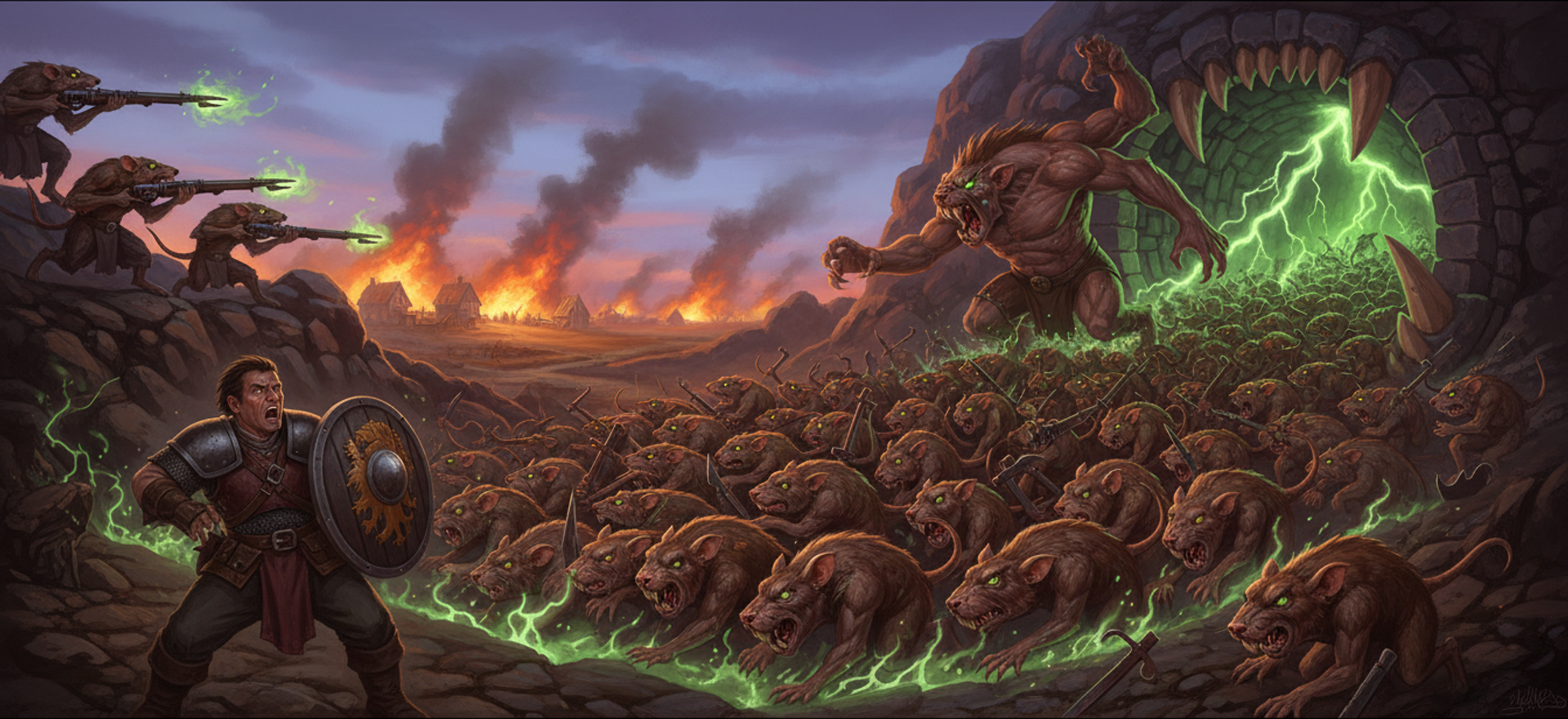
Against Ratmen, the ground changes colour and then you cannot build on it. Their corruption spreads outwards from nodes, roads and tunnel mouths, their units move 15% faster across it, and your builder refuses to put a foundation down on it. You do not lose the tile. You lose the option.
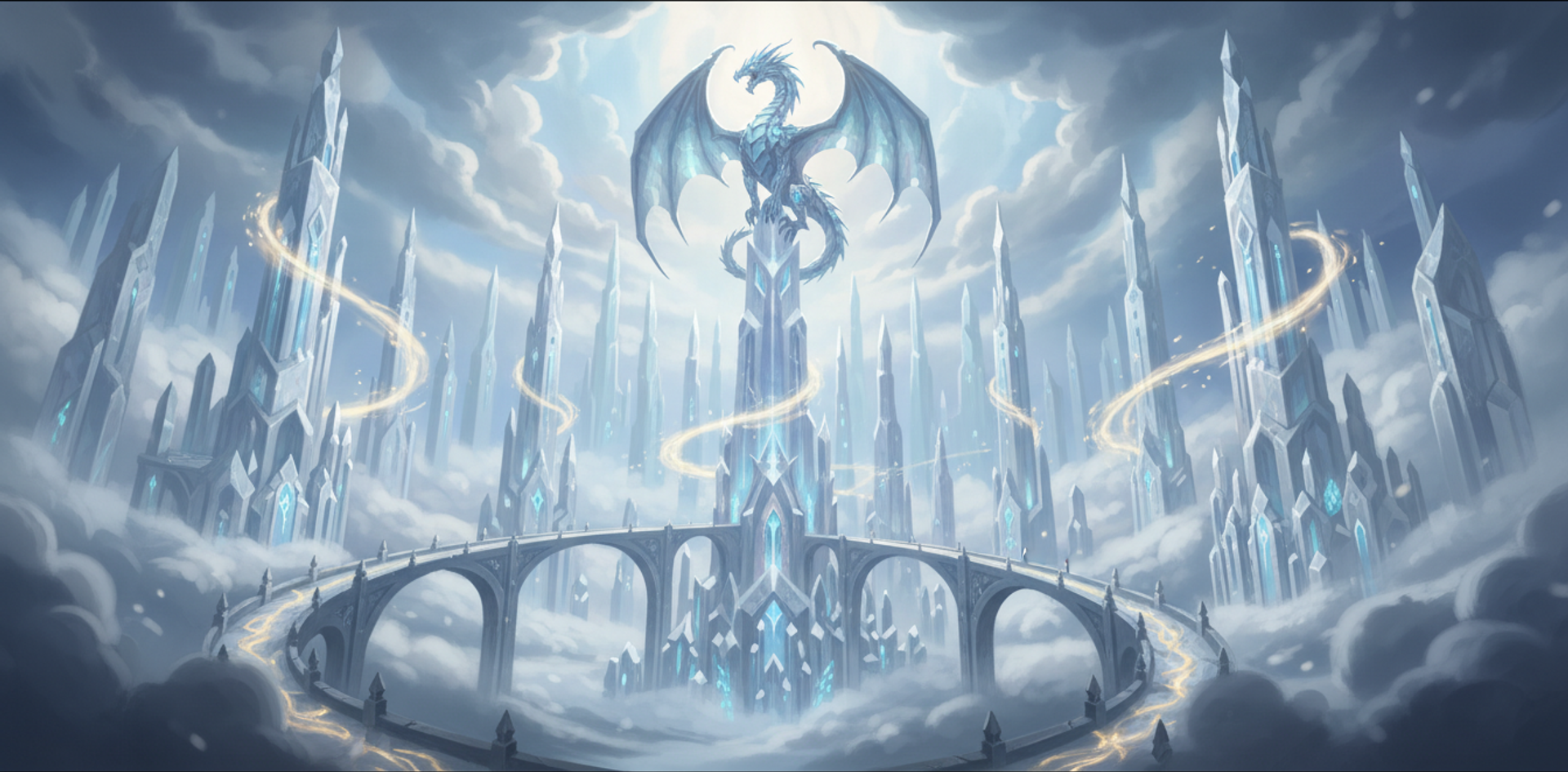
Against High Elves the same kind of constraint applies to them, and it tells you where to hit. Most of their buildings can only be placed inside a power field that reaches eight tiles out from a finished Energy Crystal. Those crystals also carry population and generate Arcane, their magic currency, so one structure does three jobs and killing it costs them all three. Raiding a High Elf expansion means going for the crystal, not the barracks.
Against Undead, standing still costs you. Every undead building bleeds one point of health per second off enemy ground troops within six tiles. It kills nothing on its own. It means a siege line parked outside their gate is losing the attrition war before the first shot.
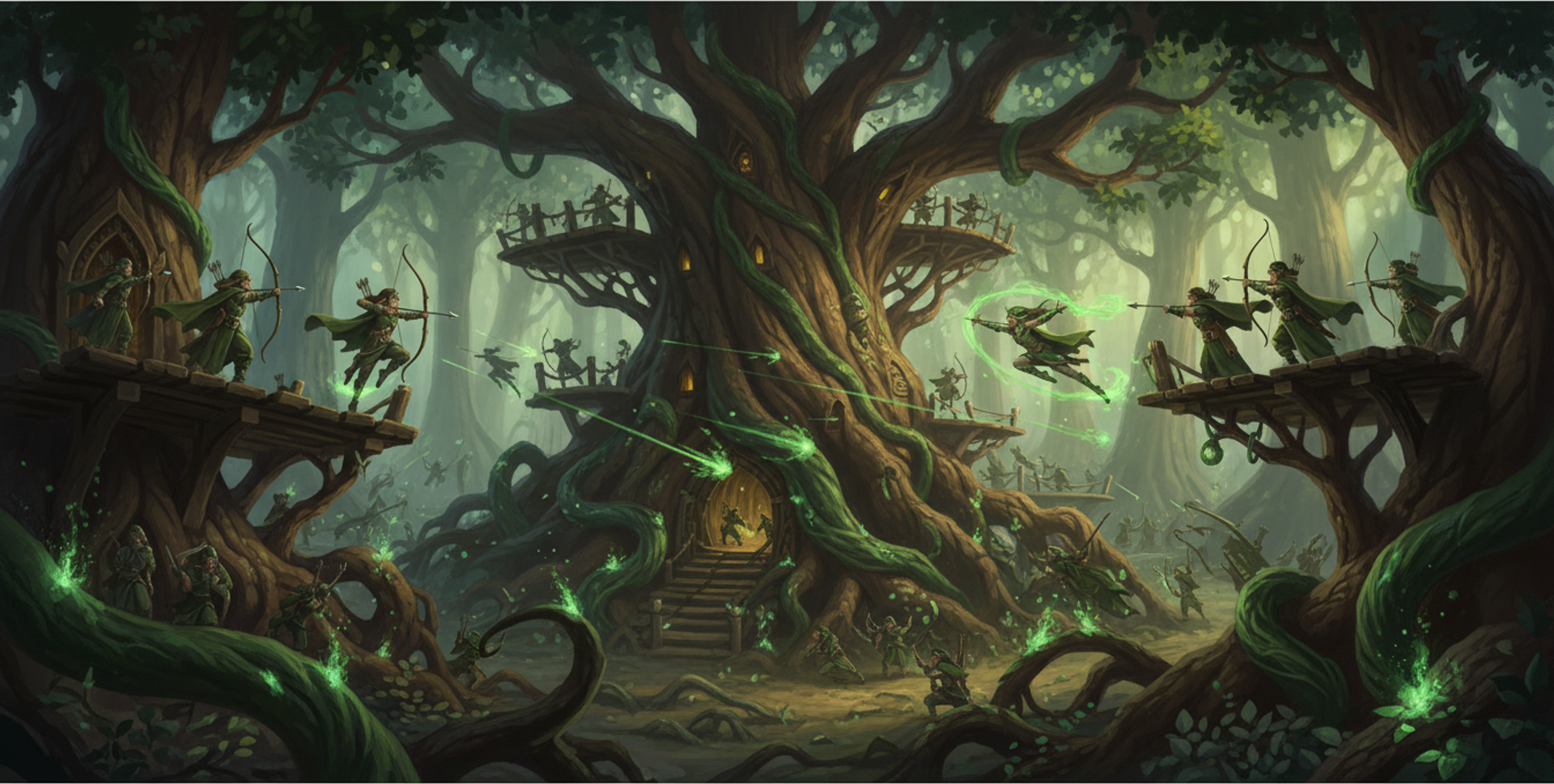
Against Wood Elves, the forest stops being a wall. Their ground troops walk straight through trees, so the treeline you were using to guard a flank is a road. Their Spirit Trees sit on the forest edge and produce lumber with no worker assigned to them, which frees their whole workforce for gold and stone.
Against Dark Elves, you go half blind. Every dark elf building cuts three tiles off the sight range of enemy units near it. Their whole roster is built to hit first and hit hard, and the blindness is the setup for it.
Against Kethraki, geometry decides the fight. Their obelisks and ward pyramids project damage and armour bonuses over an area, so the battle happens where their monuments already are, and they chose that ground long before you arrived.
Against Goblins, killing their units pays them. They recover a fifth of the gold back on their own corrupted ground, and production buildings standing on it train a quarter faster, so trading evenly with Goblins is losing slowly.
Against Dwarves, a Runic Library reaches any friendly building anywhere on the map and overcharges its production by 60% for ten seconds, on a 45 second cooldown. That is how the most defensive faction in the game produces a counterattack out of nothing.
Against Humans, a Battle Priest channels for about three seconds and your unit is theirs. Permanently, along with everything that unit's faction knows how to build.
The test that tells a mechanic from a number with a name on it
The reusable part of this work is not the nine mechanics. It is the check that separated them from the nine columns of stats they replaced, and it is two questions.
Write the mechanic as a sentence the opponent says out loud. If it comes out as "their infantry hits harder" or "their workers are cheaper", it is a number, and a player reads a number as a difficulty setting rather than as a different game. If it comes out as "I cannot build there", "the treeline is a road now" or "I have to kill the crystal before the barracks", it is a mechanic, because it has added or removed something from the list of things one of the two players can do in the next minute.
Ratmen corruption passes that test: a foundation that will not place is an option gone. A rat that trains two at a time fails it, and that was most of the faction's identity before July.
Then check that something is still running when no orders are being given. A signature that lives only as a value attached to a unit is a number wearing a name. The kind that reshapes a match has work happening continuously: ground spreading, a resource ticking up with no worker on it, corpses being hauled, a tunnel pair staying alive only while both of its ends do. If you cannot point at something the game is doing between orders, you have written flavour text.
The questions go in that order, because the second is easy to pass and the first decides whether a player notices. A sight penalty that genuinely resolves in the game is genuinely implemented. It only becomes asymmetry once something punishes being unseen, which for the Dark Elves is a roster built end to end around striking first.
None of them needed new art
The brief carried a hard constraint alongside the ambition: no new units, no new sprites, no new models. Everything had to be assembled from rules the game already had.
That constraint is what made the work take a week instead of a quarter. Anything needing art needs a generation run, a review, a rebuild, and a stretch where the game and its pictures disagree with each other. Anything built out of an existing rule is a tuning exercise you can finish in an afternoon.
So the mechanics were deliberately aimed at a small number of rules that already existed, and four of the nine landed on the same one: a building that projects an effect over a radius. The Undead drain, the Dark Elf blindness, the Kethraki obelisk and the ward pyramid are one idea with different radii, different strengths and a flag for whether it helps friends or hurts enemies.
Two more rode on ownership. Handing a unit to a different player was already a single change, and every build menu is drawn from the unit's own race rather than from the player's, which is why Convert can give you a foreign faction's entire build list with no special cases. Goblin scrap harvesting reuses the corruption already scattered across the map and the gathering the game already does, so a second economy shipped without one new model.
The tunnel is the one that changed how a map is played
Ratmen Warren Shafts change what a match looks like more than anything else on the list. A worker builds the entrance the normal way. The far end is dug on a tile you have scouted, and it surfaces with no worker there to build it, ramping up over two seconds before it can carry traffic, so a defender gets a beat to react to a hole opening behind their gold mine. Kill either end and the pair collapses.
Two details keep it from being oppressive. You cannot dig into fog you have never seen, which makes the tunnel a reward for scouting rather than a substitute for it. And the number of pairs is capped by map size: one on Small, two on Medium, three on Large, four on Huge. A cap that scales with the map does the same job as a flat build limit, but it reads as geography rather than as an imposed rule.
That far end is the only building in the game that completes with no worker standing on it. Making it the single exception is deliberate, because the exception is what makes the mechanic feel like digging rather than like building.
What a faction actually costs
The honest answer to how hard a tenth faction would be turned out to be a list rather than a number. Roughly 20 units. 30 to 35 buildings across all tiers. About 50 upgrades. 12 to 18 spells. Three or four heroes. Then around 20 unit sprites, 65 construction sprites at three stages per building, 55 portraits and 50 upgrade icons. Then about 100 acknowledgement voice lines at five per unit, 60 annoyed lines, 20 trained lines, 20 death lines, 20 building sounds and 12 music tracks.
Almost none of that is programming. What a faction costs is art, voice, music, and the design work of making it play unlike the other nine.
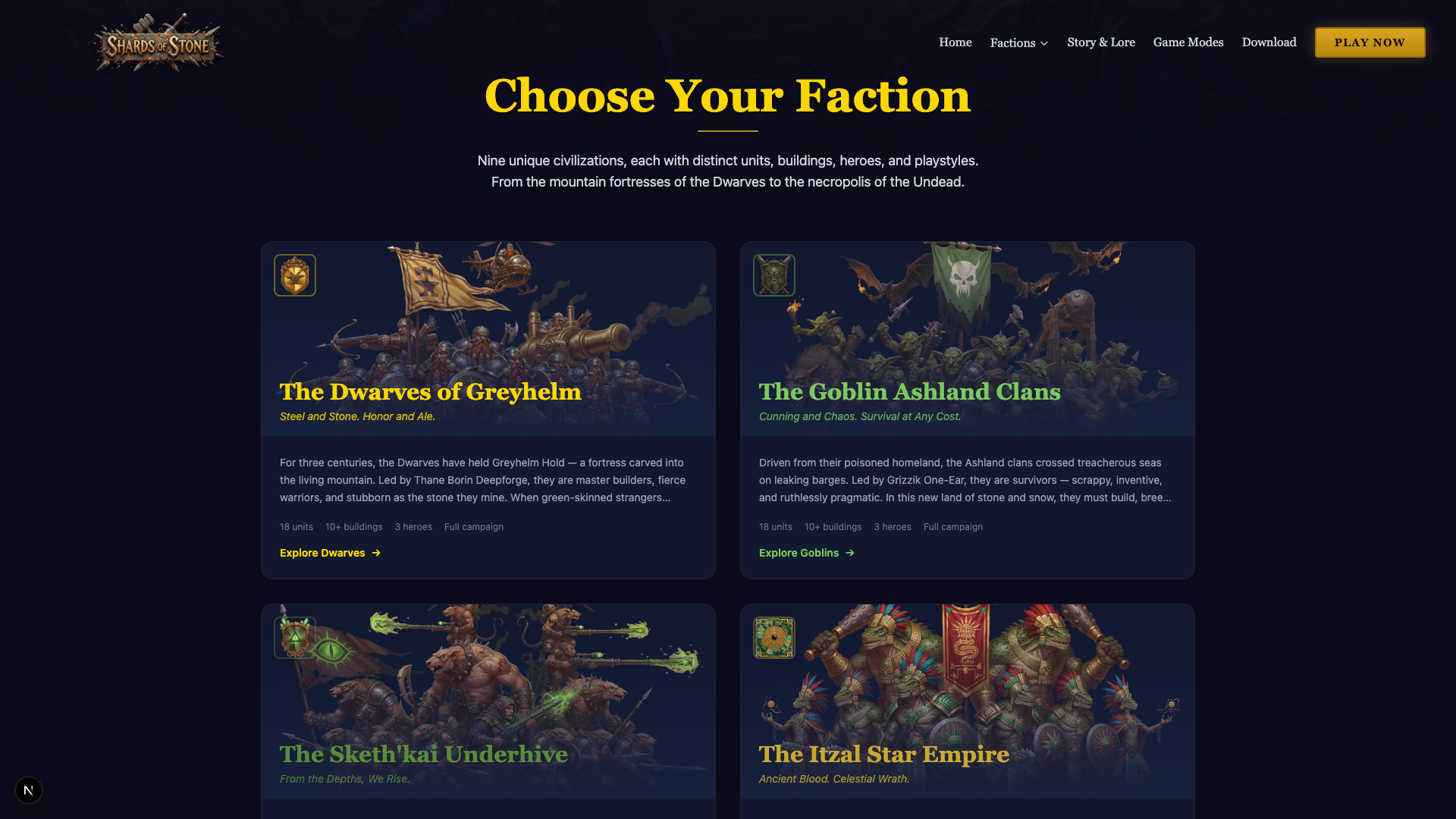
The game ships 338 units and 503 buildings across 9 playable factions, and every one of them is pickable in a skirmish or multiplayer lobby. Dwarf and Goblin also carry sixteen-mission story campaigns, which is where the world and its war gets told rather than implied.
The counter system all nine of them fight through is a separate design problem, covered in designing a counter system players can read, and the documents these mechanics were argued out in are the subject of designing a game in writing before code. The parts of the map that belong to no faction, which all nine fight over identically, are in the neutral half of the map.
The next thing on this list is not a tenth mechanic. It is the computer opponent playing all nine identities as fluently as a player does. Two are already there in a way you can watch: the Kethraki opponent builds obelisks, places them for their overlap and researches the monument line, and the goblin opponent keeps a salvage detail working its own corrupted ground and stands them down the instant its base is attacked. Teaching an opponent to dig a Warren Shaft behind your gold mine is the one I want most, because that is the mechanic players actually fear.


